Why Women Should Think Twice Before Traveling Alone in India: 7 Safety Risks Every Traveler Should Know India is a country of extraordinary contrasts. From the Taj Mahal and colorful markets to the Himalayas, ancient temples, and beautiful beaches, it offers experiences that many travelers dream of. But if you are a woman planning to explore India alone, there are important safety concerns you should understand before booking your flight. Traveling alone does not automatically mean you will have a bad experience. Many women visit India and return with wonderful memories. However, official travel advisories warn that female travelers can face unwanted attention, harassment, sexual assault, theft, and transportation-related risks. So, is India safe for solo female travelers? The honest answer is that safety varies by destination, time of day, transportation, accommodation, and individual circumstances. Here are seven important risks to consider before traveling alone in India, alon...
Get link
Facebook
X
Pinterest
Email
Other Apps
A physical therapist looked at my everyday vintage Pumas and asked if I was secretly trying to ruin my life
Get link
Facebook
X
Pinterest
Email
Other Apps
🚨 TL;DR Warning for Your Feet
If you have been daily-driving flat retro cup-sole shoes like vintage Pumas, Sambas, or low-profile court sneakers and wondering why your lower back, calves, and heels ache every single morning, your footwear is lying to you. You do not need to drop $200 on orthopedic clunkers, but you do need to stop treating 1970s indoor track soles like modern walking shoes.
I thought I beat the system last year. Sneaker hype had pushed basic Adidas Sambas and Onitsuka Tigers past the $120 mark, and there I was, picking up classic Puma Suedes and Palermos on sale for fifty bucks. They look phenomenal, they match practically every cut of denim or work trousers I own, and they do not make me look like an accountant training for an ironman at Sunday brunch.
For about eight months, I felt like a genius. I wore them to work. I wore them on 15,000-step city walks across asphalt and concrete. I wore them grocery shopping, running errands, and traveling through airports. If my shoes were on, it was a pair of flat, sleek, classic Pumas.
Then came the morning where I stepped out of bed and felt like someone drove a frozen railroad spike directly upward through my left heel. If you have ever experienced acute plantar fasciitis, you know that exact feeling: a sharp, tearing sensation that makes you limp sideways to the bathroom like a startled crab.
The Clinic Visit That Humbled My Ego
I ignored it for three weeks. I told myself I just slept weird or bruised my heel on a pebble. But the pain kept creeping upwards into my Achilles tendon, tightening my calf muscles until they felt like taut banjo strings, and eventually settling into a dull, thumping ache in my lower lumbar spine.
Finally, I booked an appointment with a physical therapist who specializes in gait analysis and running mechanics. I walked into the exam room, took off my shoes, and proudly set my navy blue Puma Suedes on the floor next to the treatment table.
The therapist looked down at my shoes, looked up at me, sighed, and asked: "Did you walk here in those? Are you actively trying to punish your calcaneus, or do you just hate having arches?"
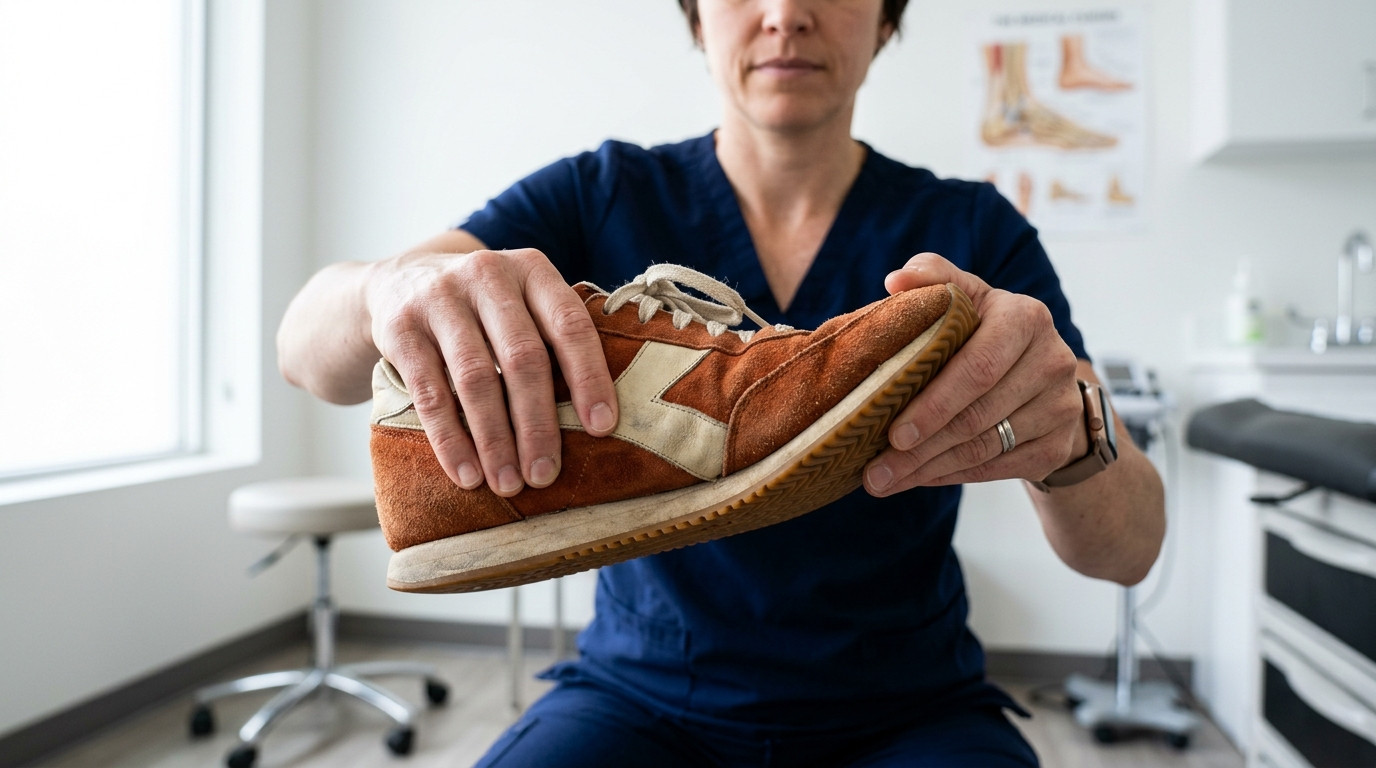
▲ Testing the sole flexibility of classic retro kicks revealed why my arches were screaming.
He picked up my sneaker, grabbed it by the heel counter and the toe box, and folded it completely in half like a soft taco. Then he twisted it lengthwise. The sole wrung out like a wet dishcloth. No torsional rigidity. Minimal heel drop. A slab of vulcanized rubber glued directly beneath a paper-thin pressed cardboard lasting board and a 2-millimeter slice of cheap EVA foam that had flattened into oblivion five months ago.
"These shoes were designed fifty years ago for short bursts on wooden basketball courts or indoor soccer turf," he explained. "Human bodies were not meant to smash hard concrete pavements for eight miles a day on a piece of dead rubber with zero midfoot shank support."
Why Modern Footwear Marketing Blindsided All of Us
Here is what happens when you switch from modern running shoes or cushioned trainers to retro low-profile lifestyle kicks: your kinetic chain bears the entire brunt of deceleration. Every time your heel strikes the pavement, forces equal to two or three times your body weight travel straight through your heel bone.
In a shoe with proper mechanical cushioning and a semi-rigid arch bridge, that force is distributed across the foot and dissipated through the sole. In vintage-style sneakers—whether they are Puma Suedes, Clydes, Speedcats, or vintage German Army Trainers—there is nothing between your plantar fascia and the unrelenting concrete sidewalk. Your intrinsic foot muscles try to clamp down to stabilize your foot, which fatigues them rapidly. Once those tiny muscles tire out, the connective tissue takes the beating.
That does not mean Puma makes bad shoes. In fact, Puma's modern running line—specifically their Nitro foam trainers—is widely considered by marathoners to be some of the best high-value footwear on the market right now. The problem is lifestyle branding: we treat retro heritage shoes built with 1968 manufacturing methods as if they are modern all-day walking instruments.
The Myth: "Just Switch to Ugly Orthopedic Shoes"
When people hit this wall of pain, the internet usually offers terrible advice. Half the forums tell you to buy barefoot shoes and walk on your forefoot like an ancestral hunter, which will completely blow out your calf muscles if you already have acute plantar heel pain. The other half tells you to give up on aesthetics entirely, buy clunky beige walking shoes with two inches of rocker foam, and dress like a tourist who lost their luggage at an airport in 1997.
Neither option works for everyday life. You want to look sharp, you want casual street style, and you do not want to spend $220 on customized podiatry orthotics that only fit inside shoes the width of a cereal box.
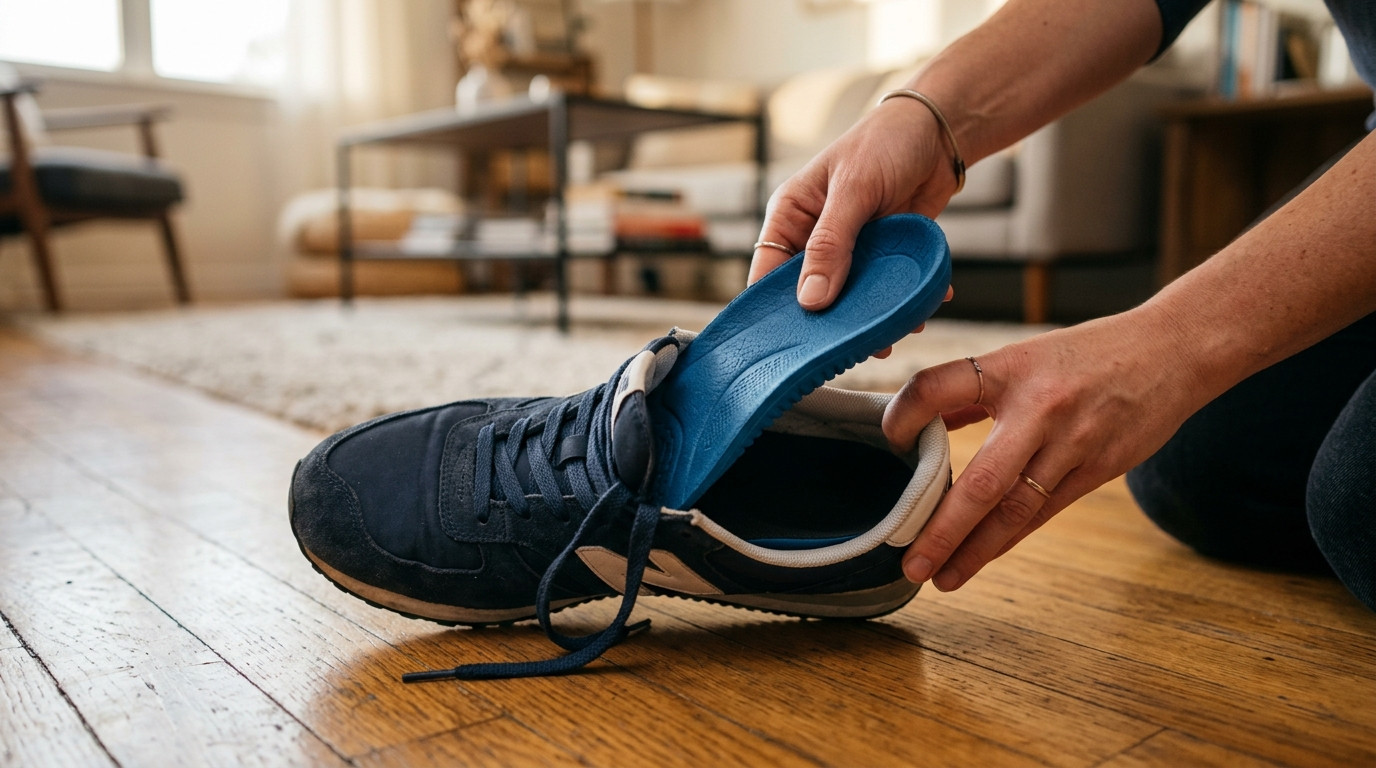
▲ A 3/4 length orthotic insert solves the support issue without cramping the toe box.
How to Wear Retro Pumas Without Destroying Your Legs
My physical therapist did not tell me to throw my favorite shoes in the garbage. Instead, he gave me a simple three-part protocol that cured my morning heel stabbing within four weeks and let me keep wearing my favorite sneakers safely.
1. Swap Out the Factory Cardboard for Rigid-Arch 3/4 Insoles
Most people buy squishy gel insoles at the drugstore. Gel is completely useless for arch collapse because it simply squishes flat under your body weight. You do not need cushion; you need structural support. Pick up a pair of stiff, three-quarter length semi-rigid orthotic inserts (brands like Superfeet Blue or Powerstep). A 3/4 length insert is critical for low-profile shoes like Pumas because it stops right behind the ball of your foot, meaning your toes do not get squished against the roof of the suede toe box.
2. The Morning Wall Calf Stretch Before Your Feet Touch Flat Ground
Plantar fasciitis flares up in the morning because your foot rests overnight in a plantar-flexed position (toes pointed down), causing the micro-tears in your arch tissue to heal in a shortened, tight state. When you stand up, you instantly re-tear that tissue. Keep a resistance band or a rolled towel by your bed. Before stepping down, loop it under your toes and gently pull backward toward your shin for thirty seconds. It prevents that violent morning shock.
3. The Shoe Rotation Rule
Never wear the exact same pair of low-profile cup-sole shoes two days in a row. Rubber needs roughly 24 to 36 hours to decompress and regain its shock-absorption properties. Alternate your low-profile Pumas with a shoe that features a higher heel-to-toe drop (around 8mm to 10mm) to offload the tension on your Achilles tendon.
The Bottom Line on Retro Kicks
I still wear my classic Pumas three days a week. I love how they look, and they still turn heads when paired with the right fit. But I took five minutes to understand what was happening under my arches, dropped twelve dollars on a rigid insole, and stopped acting like 50-year-old sports shoes could magically survive 20,000 steps on city concrete.
Treat your feet with a little mechanical respect, pay attention to the stiffness of your sneaker soles, and you will save thousands of dollars in physical therapy bills down the road.
Quick Takeaways for Foot Health
Retro flat sneakers lack midfoot rigidity, transferring pavement impact straight into your arches and lower back.
Avoid squishy gel inserts; use semi-rigid 3/4 orthotic insoles that fit shallow sneaker profiles without jamming your toes.
Stretch your calves and plantar fascia before putting weight on your heels in the morning.
Rotate flat heritage kicks with supportive everyday walkers to let the shoe foam recover and your tendons rest.
Why Women Should Think Twice Before Traveling Alone in India: 7 Safety Risks Every Traveler Should Know India is a country of extraordinary contrasts. From the Taj Mahal and colorful markets to the Himalayas, ancient temples, and beautiful beaches, it offers experiences that many travelers dream of. But if you are a woman planning to explore India alone, there are important safety concerns you should understand before booking your flight. Traveling alone does not automatically mean you will have a bad experience. Many women visit India and return with wonderful memories. However, official travel advisories warn that female travelers can face unwanted attention, harassment, sexual assault, theft, and transportation-related risks. So, is India safe for solo female travelers? The honest answer is that safety varies by destination, time of day, transportation, accommodation, and individual circumstances. Here are seven important risks to consider before traveling alone in India, alon...
"Your chronic fatigue and brain fog aren't a lack of willpower—they're a lack of gut microbes." Welcome to the era of Fibermaxxing. In 2026, Silicon Valley executives and biohackers are dropping extreme diets to focus on the ultimate performance enhancer: The Gut-Brain Axis. 1. The End of the Protein Obsession For years, fitness culture was entirely obsessed with "high protein, low carb." We filled our fridges with chicken breasts and protein powders. But as we move deep into 2026, the paradigm has shifted. High performers are now turning their attention away from protein and toward Fiber . Enter 'Fibermaxxing' . Instead of restricting food groups and inducing metabolic stress, people are dramatically increasing their intake of complex, high-quality fibers—like lentils, beans, and whole grains—to reduce systemic inflammation and unlock ...
The 2026 Wellness Shift: Why 'Sleep Recovery' is the Ultimate Weight Loss Hack "I am eating less and working out endlessly, but the scale won't budge." This is the universal frustration of chronic dieters. However, as we move through 2026, the global wellness industry and viral TikTok trends have abruptly shifted focus away from high-intensity workouts and extreme caloric deficits. Today, top fitness experts and Silicon Valley biohackers are obsessed with one metric above all else: Data-Driven Sleep Recovery . When you are sleep-deprived, your body enters a state of primal emergency, aggressively storing fat around your midsection. Conversely, when you optimize your sleep architecture, your body becomes an ultra-efficient fat-burning furnace overnight. In this deep dive, we explore the trending science behind the sleep-optimization diet and provide actionable protocols you can implement tonight to transform your metabolism. Photo: Cultivatin...



Comments
Post a Comment