🚨 Your expensive ergonomic office chair is actively ruining your joints. I spent thousands of dollars trying to buy my way out of chronic lower back stiffness and clicking knees, only to find out that the furniture industry is lying to us. The actual fix to your physical misery is completely free, and it's the exact same mobility strategy used by world-class athletes who squat for a living. The Ergonomic Trap and My $1,200 Mistake For the past four years, my daily routine consisted of waking up, shuffling over to my desk, and sitting for nine to ten hours. About two years ago, the cracks started to show. It began with a dull ache in my lower lumbar spine. Then, my knees started popping like bubble wrap every time I stood up to get a glass of water. Walking down stairs felt like my patellar tendons were being stretched over broken glass. Naturally, I did what any desperate desk worker does: I threw money at the problem. I bought a highly rated ergonomic mesh chair that...
Get link
Facebook
X
Pinterest
Email
Other Apps
Stop paying €2,000 rent in Western Europe. I moved my entire remote job from the Netherlands to Serbia and saved my sanity (and $25k a year)
Get link
Facebook
X
Pinterest
Email
Other Apps
🚨 I was paying 65% of my post-tax income just to rent a drafty apartment in Utrecht where the landlord wouldn't even fix the heating. I packed up, moved to Belgrade, and cut my living expenses by 70%. Here is the raw financial breakdown of what actually happens when you swap Western Europe for the Balkans.
The Breaking Point: Suffering Through the Dutch Housing Crisis
Let's talk about the absolute state of renting in Western Europe right now. If you've tried to find an apartment in Amsterdam, Utrecht, or Rotterdam over the last couple of years, you know it's not just a housing market—it's a blood sport. I was living in Utrecht, working a decent remote tech job, and taking home about €3,400 after taxes. Sounds great on paper, right? Except €1,800 of that went straight to a cold, moldy 45-square-meter apartment where the radiator clanked all night and the landlord treated me like an inconvenience. When my energy bill tripled and my landlord announced a €150 rent hike, I realized I was working 40 hours a week just to fund someone else's mortgage while eating discount pasta. I was trapped in a cycle of high-cost living with zero room to save for a future. That is when I decided to look outside the Western European bubble. I wanted a place with fast internet, great food, vibrant culture, and a cost of living that didn't feel like a slow-motion robbery. After weeks of comparing destinations, I kept seeing Serbia pop up. It was a direct contrast to the highly regulated, painfully expensive Dutch lifestyle. I bought a ticket to Belgrade, packed my life into two suitcases, and decided to run a six-month experiment. That experiment has now turned into two years, and the financial difference is mind-blowing.
The Cold Financial Math: Belgrade vs. Utrecht
Let's look at the actual numbers because people often think moving to Eastern Europe means living in a run-down concrete block with dial-up internet. That is a massive misconception. In Utrecht, my fixed monthly costs were crippling: €1,800 for rent, €220 for utilities and energy, €140 for mandatory health insurance, and at least €400 on basic groceries. That's over €2,500 gone before I even bought a single cup of coffee or paid for transport. In Belgrade, my life looks entirely different. I rent a gorgeous, modern, high-ceilinged apartment in Dorćol—one of the most historic and trendy neighborhoods in the city—for €600 a month. My utilities, including lightning-fast fiber internet and central heating, average about €90. I don't need a €150-a-month health insurance policy because private healthcare here is incredibly affordable; a comprehensive private insurance plan costs me about €40 a month, and out-of-pocket doctor visits are around €30 if I need to see a specialist immediately. My total fixed living costs dropped from €2,500 to under €850. I am saving over €1,600 every single month just by existing in a different timezone. Over a year, that is nearly €20,000 back in my investment portfolio instead of my old Dutch landlord's pocket.
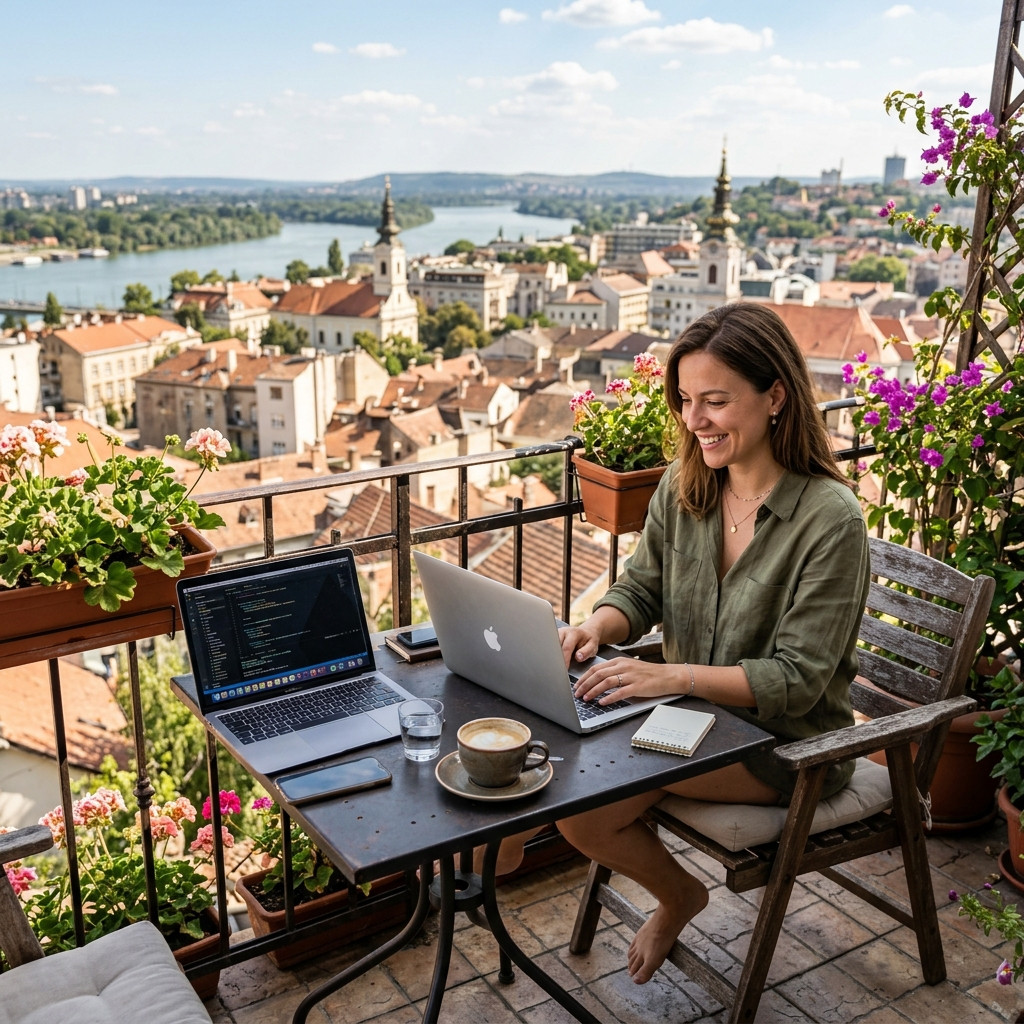
▲ Trading the rainy streets of Utrecht for the vibrant cafe culture of Belgrade was a game-changer for my productivity and my wallet.
The Bureaucratic Nightmare: Getting Legal in Serbia
Now, let's address the inevitable catch. Moving from an EU country like the Netherlands to a non-EU country like Serbia isn't as simple as hopping on a train. You can't just show up and live there forever without paperwork. In the Netherlands, bureaucracy is highly digitized but incredibly rigid. In Serbia, bureaucracy is a chaotic mix of old-school paper files, stamp-collecting, and sudden rule changes. When you arrive, you have to register with the local police within 24 hours to get your white card (beli karton). If you stay in a hotel, they do this for you, but if you rent an apartment, you and your landlord must physically go to the police station together. It's an intimidating process if you don't speak Serbian. To stay long-term, you need a temporary residence permit. I chose the route of opening a local entrepreneur business, which allowed me to pay a flat monthly tax rate of about €300. This granted me residency and a local bank account. Is it annoying? Yes. Did I have to hire a local lawyer and accountant to navigate the paperwork? Absolutely. It cost me about €500 in professional fees, but it saved me weeks of headaches. If you're planning this move, do not try to DIY the immigration paperwork. Pay a local professional to handle it.
Tax Optimization: How I Kept More of My Paycheck
One of the biggest financial shocks of living in the Netherlands is the income tax. If you earn a decent salary, you're looking at a tax rate of up to 49.5%. Even with the famous 30% ruling for expats, you still end up paying a massive chunk of your income to the Dutch government. While you get excellent public infrastructure in return, it makes wealth accumulation incredibly slow. In Serbia, the tax landscape for remote workers and freelancers is highly favorable if structured correctly. By setting up as a flat-rate entrepreneur, I pay a fixed tax amount every month regardless of how much I earn, up to a limit of around €50,000 per year. For me, this flat tax is roughly €320 a month. This means my effective tax rate dropped from nearly 35% in the Netherlands to less than 10% in Serbia. This single optimization allowed me to keep thousands of extra euros of my hard-earned money every year. However, you must ensure your contracts comply with local regulations to avoid being classified as a disguised employee. Again, this is where a good local accountant is worth their weight in gold.
The Lifestyle Shift: Spontaneity vs. The Agenda
Beyond the raw financial savings, the cultural shift between these two countries is night and day. In the Netherlands, life is governed by the agenda. If you want to grab a beer with a friend or visit a colleague, you often have to schedule it three weeks in advance. Everything is planned, optimized, and slightly sterile. People are polite, but breaking into local social circles is notoriously difficult for expats. Serbia is the exact opposite. Life here is spontaneous, loud, and incredibly social. Cafes are packed at 2:00 PM on a Tuesday with people laughing, drinking espresso, and talking passionately. You don't need to schedule a meetup weeks in advance; you just text a friend and meet up 20 minutes later. The hospitality here is unmatched. Locals are genuinely curious about foreigners and will go out of their way to help you, invite you to their homes, and share their culture. If you enjoy a vibrant, community-focused lifestyle where work doesn't define your entire identity, the Balkan social scene is an absolute breath of fresh air.
The Real Downsides: What Nobody Tells You on Instagram
I am not here to sell you a flawless fantasy. Moving to Belgrade comes with real trade-offs that might be dealbreakers for some. First, the air quality in winter is genuinely bad. Because many households in surrounding areas still burn coal and wood for heating, Belgrade frequently ranks high on global air pollution indexes between November and February. You will need to buy a high-quality air purifier for your apartment. Second, smoking is still permitted indoors in many restaurants, cafes, and bars. Coming from the highly regulated, smoke-free environments of Western Europe, this was a massive shock to my system. You will come home from a night out smelling like an ashtray. Lastly, public transport in Belgrade is lightyears behind the seamless Dutch train and cycling network. There is no metro system yet, and the buses can be crowded, hot, and unreliable. If you're used to cycling everywhere on dedicated, pristine bike lanes, you will have to adjust to walking or relying on affordable local taxi apps.
The Verdict: Was the Trade-off Worth It?
Two years into this journey, I can confidently say that leaving the high-rent trap of Western Europe was the best financial move I've ever made. I went from barely saving €300 a month to consistently putting away over €2,000 a month. I've been able to maximize my investment accounts, travel extensively, and live in a spacious, beautiful home without constant financial anxiety. Yes, the bureaucracy can be frustrating, the winter air is smoky, and I miss the pristine Dutch cycling lanes. But the trade-off—gaining complete financial freedom and experiencing a warm, welcoming, and spontaneous culture—has been worth every single hurdle. If you are tired of spending your entire youth working to pay off someone else's mortgage in an overpriced Western European city, it might be time to look East.
Summary of My Move
Rent Savings: Cut monthly housing costs from €1,800 to €600.
Tax Optimization: Swapped Dutch income taxes for a flat €320/month business tax.
Lifestyle: Traded rigid scheduling for spontaneous, vibrant Balkan cafe culture.
The Catch: Be prepared for winter air pollution, indoor smoking, and intense paperwork.
"Your chronic fatigue and brain fog aren't a lack of willpower—they're a lack of gut microbes." Welcome to the era of Fibermaxxing. In 2026, Silicon Valley executives and biohackers are dropping extreme diets to focus on the ultimate performance enhancer: The Gut-Brain Axis. 1. The End of the Protein Obsession For years, fitness culture was entirely obsessed with "high protein, low carb." We filled our fridges with chicken breasts and protein powders. But as we move deep into 2026, the paradigm has shifted. High performers are now turning their attention away from protein and toward Fiber . Enter 'Fibermaxxing' . Instead of restricting food groups and inducing metabolic stress, people are dramatically increasing their intake of complex, high-quality fibers—like lentils, beans, and whole grains—to reduce systemic inflammation and unlock ...
The 2026 Wellness Shift: Why 'Sleep Recovery' is the Ultimate Weight Loss Hack "I am eating less and working out endlessly, but the scale won't budge." This is the universal frustration of chronic dieters. However, as we move through 2026, the global wellness industry and viral TikTok trends have abruptly shifted focus away from high-intensity workouts and extreme caloric deficits. Today, top fitness experts and Silicon Valley biohackers are obsessed with one metric above all else: Data-Driven Sleep Recovery . When you are sleep-deprived, your body enters a state of primal emergency, aggressively storing fat around your midsection. Conversely, when you optimize your sleep architecture, your body becomes an ultra-efficient fat-burning furnace overnight. In this deep dive, we explore the trending science behind the sleep-optimization diet and provide actionable protocols you can implement tonight to transform your metabolism. Photo: Cultivatin...
🌙 When was the last time you woke up actually feeling rested? Let’s be honest. Surviving the morning on three cups of coffee and doom-scrolling until 2 AM despite being exhausted has become the norm for too many of us. But in 2026, the global elite and high-performing Millennials are flipping the script. They aren't boasting about running on 3 hours of sleep anymore. Instead, they are obsessing over 'Sleepmaxxing' —the art of using cutting-edge Sleep Tech to hack their biology and achieve the most brutally efficient, restorative deep sleep possible. 1. Quality Over Quantity: The Era of 'Amplified Efficiency' It's no longer just about sleeping for 8 hours; it's about how you sleep. The 2026 sleep industry is dominated by the concept of 'Amplified Efficiency.' High-achievers are aiming to get the restorative equivalent of 10 hours of sleep in just 6 hours. How? Through active intervention. AI-pow...



Comments
Post a Comment