🚨 Your expensive ergonomic office chair is actively ruining your joints. I spent thousands of dollars trying to buy my way out of chronic lower back stiffness and clicking knees, only to find out that the furniture industry is lying to us. The actual fix to your physical misery is completely free, and it's the exact same mobility strategy used by world-class athletes who squat for a living. The Ergonomic Trap and My $1,200 Mistake For the past four years, my daily routine consisted of waking up, shuffling over to my desk, and sitting for nine to ten hours. About two years ago, the cracks started to show. It began with a dull ache in my lower lumbar spine. Then, my knees started popping like bubble wrap every time I stood up to get a glass of water. Walking down stairs felt like my patellar tendons were being stretched over broken glass. Naturally, I did what any desperate desk worker does: I threw money at the problem. I bought a highly rated ergonomic mesh chair that...
Get link
Facebook
X
Pinterest
Email
Other Apps
Stop buying sports cards of teenage prospects. Here is how the hobby became a predatory casino.
Get link
Facebook
X
Pinterest
Email
Other Apps
🚨 I treated teenager baseball cards like tech stocks, and my bank account paid the price.
I need to get this off my chest because I see thousands of people falling into the exact same trap every single day. If you’ve spent any time on sports forums, Instagram, or TikTok lately, you’ve probably seen the absolute frenzy surrounding prospect card flipping. We aren't talking about buying a Michael Jordan or LeBron James rookie card anymore. We are talking about buying autographed chrome cards of 17 and 18-year-old kids who haven't even had a legal beer yet, let alone stepped onto a Major League field.
A few years ago, I fell hard down this rabbit hole. I convinced myself I was an "investor." I told my partner that buying Bowman Chrome cards of teenage prospects was just like getting in on ground-floor IPOs before they hit the public market. I spent hours analyzing minor league spray charts, exit velocities, and scouting reports on prospects. I was convinced I was smarter than the market. Spoiler alert: I wasn't. I lost nearly $8,000 before I finally woke up and realized that the modern sports card hobby has mutated into an unregulated, predatory casino designed to drain your savings.
The Hype Trap: The Obsession with the "Next Big Thing"
To understand how this trap works, you have to look at how the industry markets players. Take a player like Josue De Paula, for example. He's an incredibly talented young outfielder in the Los Angeles Dodgers system. He’s got beautiful swing mechanics, great plate discipline, and projectable power. If you read the scouting forums or watch sports card "influencers" on YouTube, they talk about him like he’s a guaranteed future Hall of Famer. They’ll tell you to buy his 1st Bowman Chrome autographed cards now before they "go to the moon" when he finally makes his debut in Dodger Stadium.
And that’s how they get you. You look at a kid like De Paula, you see the Dodgers player development machine behind him, and you think, "If I buy five of his autographed cards for $300 each now, they’ll be worth $3,000 each when he gets called up to LA." It sounds so logical. You think you're investing in talent. But in reality, you are playing a highly manipulated game of hot potato where the odds are heavily stacked against you. You are betting on the erratic development of a teenager while competing against institutional-level card dealers and breakers who manipulate the prices behind the scenes.
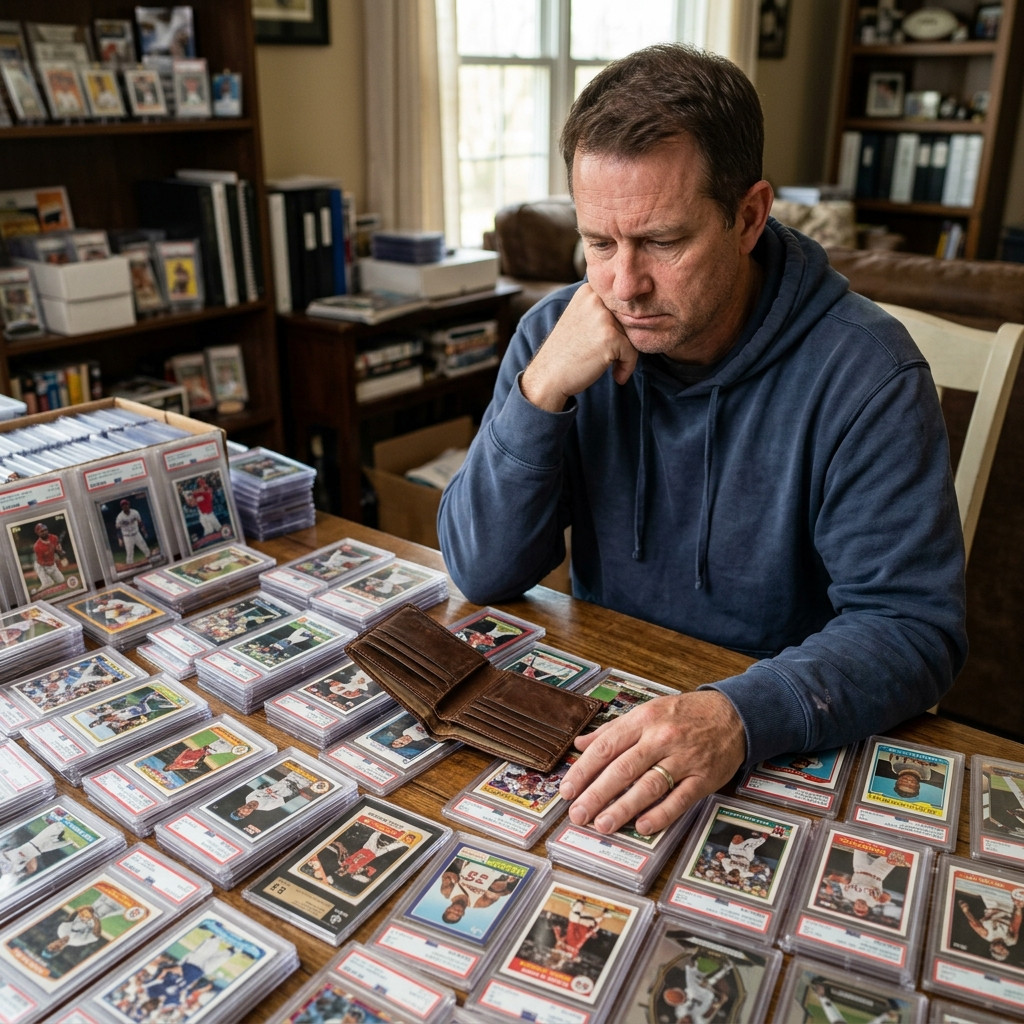
▲ Treating sports cards like volatile stocks is a fast track to financial anxiety.
The Cold, Hard Math of Baseball Prospecting
Let's look at the actual math of what has to happen for a prospect card investment to actually pay off. It is mind-bogglingly risky. When you buy a prospect's card at peak hype, you are paying a price that already factors in them becoming an All-Star. You are buying at the absolute ceiling. The margin for error is non-existent.
For your "investment" to double or triple, that player has to go through an absolute gauntlet:
Avoid major, career-altering injuries: Pitchers need Tommy John surgery at alarming rates, and young position players frequently suffer shoulder, wrist, or hamstring issues that permanently sap their power or speed.
Consistently hit professional pitching: The jump from Low-A to Double-A is notorious for breaking prospects. Pitchers start throwing nasty sliders with actual movement, and hitters who dominated high school fastballs suddenly find themselves striking out 35% of the time.
Survive the pressure of major media markets: If a prospect gets traded from a high-profile team like the Dodgers or Yankees to a low-profile small-market team, their card values instantly plummet by 50% or more, regardless of how well they perform on the field.
Maintain a clean off-field reputation: One bad mistake off the field can render a player's cards completely worthless overnight.
If even one of those things goes wrong, the value of that card drops by 80% overnight. I bought into a dozen different "can't-miss" prospects three years ago. Two of them got serious shoulder injuries, three of them stalled out in Double-A because they couldn't hit a breaking ball, and the rest are utility players whose cards are now worth less than the cost of the plastic loaders they are stored in. The risk-to-reward ratio is completely broken, yet we treat it like a savvy financial move.
How the Industry Manufactures FOMO
The sports card industry is no longer a hobby; it is a highly coordinated hype machine. Manufacturers like Topps/Fanatics, grading companies like PSA, and high-profile "breakers" on social media have created a perfect ecosystem to extract money from collectors. They use casino-style tactics to keep you hooked, utilizing bright colors, shiny finishes, and the thrill of the "pull."
First, you have "breaks." Instead of buying a box of cards yourself—which has become prohibitively expensive, with some hobby boxes costing upwards of $500 to $1,000—you pay $50 to $150 for a "spot" in a live break. A streamer opens boxes live on camera, and you get whatever cards are pulled for a specific team you were assigned or purchased. It is pure, unadulterated gambling. You watch the chat scroll by at lightning speed, the music pumping in the background, the streamer screaming when they pull a rare parallel of a hyped prospect. Your brain gets flooded with dopamine, and before you know it, you’ve spent your rent money trying to hit a gold refractor of the latest teenage phenom. You are chasing a high, not building a collection.
Then there is the artificial scarcity. There aren't just base cards anymore; there are refractor parallels in every color of the rainbow—refractors, shimmers, waves, mojo refractors, printing plates, and sparkfractor editions. They create dozens of different versions of the exact same card to make you feel like you are getting something incredibly rare, when in reality, they are printing more cards than they ever have in history. The "junk wax" era of the 1990s hasn't ended; it has just been repackaged as the "junk slab" or "junk parallel" era.
The Illusion of Liquidity and the Grading Trap
Another massive trap I fell into was believing that my collection was highly liquid. I’d look at eBay "comps" (completed sales) and think, "Wow, my collection is worth $12,000!" But there is a massive difference between what a card is theoretically worth and what you can actually get for it when you need cash to pay your bills.
When you want to sell, you quickly realize how much the fees eat you alive. eBay takes roughly 13% to 15% of the total transaction. If you use a consignment service, they take their cut. If you sell at a local card show, dealers will offer you 60% to 70% of the recent sales value because they need to make a profit too. And if a player has a bad week or gets injured, the market for their cards completely evaporates. You can't sell them at any price. You are left holding highly volatile, illiquid cardboard assets while your real-world bills pile up.
Furthermore, the grading trap is a massive money pit. We are told that we must send every card to PSA or Beckett to get graded a "Gem Mint 10." If your card gets a 9 instead of a 10, the value can drop by 50% or more instantly. You pay $15 to $50 per card for grading, wait months to get them back, and by the time they return, the player might have slumped, rendering the entire endeavor a net loss. You are literally paying third-party companies to tell you how perfect your piece of cardboard is, just so you can try to sell it to another speculator who is trying to do the exact same thing.
The Rise of the Sports Card Influencer and Market Manipulation
We also need to talk about the dark side of sports card "influencers." There is a massive conflict of interest in this hobby that nobody wants to address. Many of the prominent YouTube channels, Instagram pages, and TikTok creators who pump up prospects like Josue De Paula or other young talents are actually holding massive inventories of those exact cards. They are using their platforms to pump the market, create artificial demand, and then quietly dump their graded cards onto unsuspecting collectors who think they are getting "expert tips."
It is classic pump-and-dump behavior, completely unregulated because sports cards are not classified as securities. If a financial advisor did this with stocks, they would be facing federal prison time. But in the sports card world, it’s just called "content creation" and "market analysis." They will show you charts of a player’s card prices rising over the last month, claiming it’s a "strong buy trend," without mentioning that they and their dealer buddies bought up 80% of the available supply to force those prices up. You are buying into a rigged game where the house always wins.
The Harsh Reality of Minor League Baseball Development
When you invest in a young prospect, you are also ignoring the sheer brutality of the minor league system. Baseball is one of the hardest sports in the world to project. In basketball or football, a top-five draft pick is almost guaranteed to play in the pros immediately and make an impact. In baseball, even the most elite first-round draft picks usually spend three to five years grinding in the minor leagues, playing in front of tiny crowds, riding buses across the country, and earning less than minimum wage.
During those years, anything can go wrong. A player's swing mechanics can get messed up by a well-meaning hitting coach. They can lose their confidence after a bad month. They can struggle with the mental toll of being away from home at such a young age. The success rate for even the most highly touted "top 100" prospects is incredibly low. When you pay hundreds of dollars for an unproven player's card, you are betting against decades of historical data showing that most prospects simply do not make it. You are buying the sizzle, but there is a very high chance you will never get the steak.
The Psychological Toll of the "Card Grustle"
What shocked me the most was the psychological toll this "grustle" (grind + hustle) took on me. I stopped enjoying baseball. I used to love sitting down on a summer evening to watch a game. Once I started investing in prospects, I wasn't watching the game for fun anymore. I was constantly checking box scores of minor league teams in places like Great Lakes or Chattanooga. If a prospect went 0-for-4 with three strikeouts, my night was ruined. I felt a knot in my stomach. I was tying my happiness and my financial well-being to the performance of teenagers playing in front of half-empty stadiums in the middle of nowhere.
It turns a beautiful, relaxing sport into a source of constant low-grade anxiety. You become hyper-fixated on market trends, checking sales charts on sports card market apps, and debating stranger-opinions on forums. You lose sight of why you fell in love with sports in the first place.
How to Break the Cycle and Reclaim Your Wallet
If you love sports and still want to enjoy the hobby without ruining your personal finances, you have to completely change your mindset. Here is how I managed to rebuild my relationship with the hobby after losing thousands of dollars:
1. Stop buying "prospects" entirely. If you want to buy cards, buy established, historical legends. Buy Ken Griffey Jr., Ichiro, Albert Pujols, or Clayton Kershaw. Their places in baseball history are set in stone. Their card values don't swing wildly because of a bad game in Double-A or a sudden elbow strain. They are stable, fun collectibles, not speculative lottery tickets.
2. Never, under any circumstances, participate in live breaks. It is the fastest way to lose money in the entire hobby. If you want a specific card, just buy the "single" on eBay. It might feel less exciting than "hitting" it in a break, but you will save thousands of dollars in the long run. Buying singles is the ultimate cheat code of the sports card hobby.
3. Set a strict monthly "fun budget" and treat it as gone. If you allocate $50 a month to sports cards, treat that money as if you spent it on a nice dinner or a movie ticket. Do not view it as an investment. If the cards go to zero, it shouldn't impact your financial goals, your savings, or your peace of mind.
4. Unfollow the hype accounts. Unsubscribe from the YouTube channels that talk about cards as "assets" and "portfolios." Block the Instagram accounts that show off six-figure card deals. They are selling a lifestyle and an illusion to keep the bubble inflated so they can dump their cards on you.
TL;DR / Key Takeaways
The Hype is Manufactured: The sports card industry relies on extreme FOMO to sell overpriced boxes of cards featuring teenagers who haven't played a single Major League game.
High Risk, Low Reward: Speculating on prospects like Josue De Paula is a statistical losing game. The vast majority of prospects never live up to their card market valuations.
It's an Illiquid Market: Selling your cards quickly is incredibly difficult and expensive once you factor in platforms fees, shipping, and sudden market drops.
Keep it a Hobby: Buy singles of players you actually love, stay far away from live breakers, and never view cardboard as a legitimate financial investment.
"Your chronic fatigue and brain fog aren't a lack of willpower—they're a lack of gut microbes." Welcome to the era of Fibermaxxing. In 2026, Silicon Valley executives and biohackers are dropping extreme diets to focus on the ultimate performance enhancer: The Gut-Brain Axis. 1. The End of the Protein Obsession For years, fitness culture was entirely obsessed with "high protein, low carb." We filled our fridges with chicken breasts and protein powders. But as we move deep into 2026, the paradigm has shifted. High performers are now turning their attention away from protein and toward Fiber . Enter 'Fibermaxxing' . Instead of restricting food groups and inducing metabolic stress, people are dramatically increasing their intake of complex, high-quality fibers—like lentils, beans, and whole grains—to reduce systemic inflammation and unlock ...
The 2026 Wellness Shift: Why 'Sleep Recovery' is the Ultimate Weight Loss Hack "I am eating less and working out endlessly, but the scale won't budge." This is the universal frustration of chronic dieters. However, as we move through 2026, the global wellness industry and viral TikTok trends have abruptly shifted focus away from high-intensity workouts and extreme caloric deficits. Today, top fitness experts and Silicon Valley biohackers are obsessed with one metric above all else: Data-Driven Sleep Recovery . When you are sleep-deprived, your body enters a state of primal emergency, aggressively storing fat around your midsection. Conversely, when you optimize your sleep architecture, your body becomes an ultra-efficient fat-burning furnace overnight. In this deep dive, we explore the trending science behind the sleep-optimization diet and provide actionable protocols you can implement tonight to transform your metabolism. Photo: Cultivatin...
🌙 When was the last time you woke up actually feeling rested? Let’s be honest. Surviving the morning on three cups of coffee and doom-scrolling until 2 AM despite being exhausted has become the norm for too many of us. But in 2026, the global elite and high-performing Millennials are flipping the script. They aren't boasting about running on 3 hours of sleep anymore. Instead, they are obsessing over 'Sleepmaxxing' —the art of using cutting-edge Sleep Tech to hack their biology and achieve the most brutally efficient, restorative deep sleep possible. 1. Quality Over Quantity: The Era of 'Amplified Efficiency' It's no longer just about sleeping for 8 hours; it's about how you sleep. The 2026 sleep industry is dominated by the concept of 'Amplified Efficiency.' High-achievers are aiming to get the restorative equivalent of 10 hours of sleep in just 6 hours. How? Through active intervention. AI-pow...



Comments
Post a Comment