🚨 If your only personal time happens after midnight, read this. I convinced myself for thirty-six months that binge-watching political desk comedy in the pitch black was just 'harmless unwinding.' It turns out, stealing sleep to reclaim your stolen daylight carries an invisible interest rate that almost wrecked my nervous system. Picture this routine: 11:30 PM rolls around. My work laptop closes after a grinding nine-hour shift at a tech consultancy where every manager communicates purely through urgent Slack pings. I brush my teeth, crawl under the duvet, and swear on everything holy that tonight is the night I get eight solid hours of restorative rest. Then, my thumb autonomously reaches for my phone on the nightstand. I unlock YouTube. In the recommended feed, there it is: a fresh 18-minute segment of Late Night with Seth Meyers —specifically 'A Closer Look.' I tell myself, 'Just one video. I need a laugh. Seth's sarcastic delivery about the day...
Get link
Facebook
X
Pinterest
Email
Other Apps
I tried to watch a simple Reds vs Braves game and realized MLB is actively hostile to its own fans. Here is how to stop getting ripped off.
Get link
Facebook
X
Pinterest
Email
Other Apps
🚨 Stop throwing your hard-earned money at MLB.tv and stadium scalpers. The entire system is rigged to drain your wallet, but there are dead-simple ways to fight back.
I am a lifelong baseball fan. I grew up listening to games on a crackly AM radio and spending my summers chasing foul balls. But last week, I hit my absolute breaking point. I wanted to sit down on a Tuesday night and watch a highly anticipated matchup between the Cincinnati Reds and the Atlanta Braves. Simple request, right? I don't live in Cincinnati, and I don't live in Atlanta. I live in a mid-sized city about 350 miles away from both stadiums.
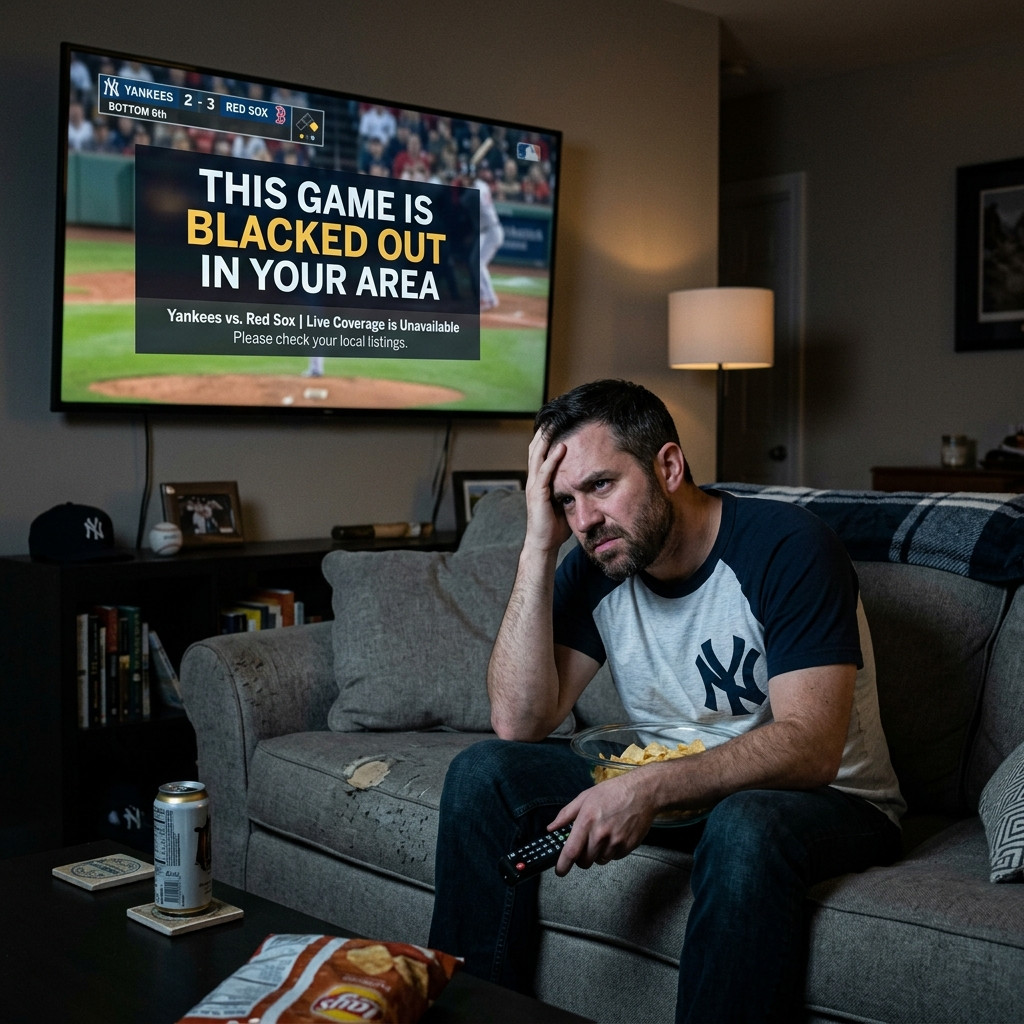
Since I cut the cord years ago to escape a $140 monthly cable bill, I did what MLB constantly begs us to do: I signed up for their premium streaming service, MLB.tv. I paid my money, fired up the app on my Apple TV, grabbed a cold drink, and clicked on the game. Instead of the opening pitch, I was greeted by a cold, gray screen with the dreaded text: 'This event is blacked out in your area.'
How? How on earth is a game happening hundreds of miles away in another state blacked out for a paying customer? It turns out my entire region is claimed by a bankrupt regional sports network that I couldn't subscribe to even if I wanted to. I was locked out of a product I literally just paid for. Frustrated, I looked up ticket prices to actually go drive and see the series in person, only to find myself staring down the barrel of algorithmic ticket pricing, $40 parking, and $18 beers. The entire modern sports ecosystem has become a hostiles-only zone for normal working-class fans.
▲ The reality of modern sports streaming: paying premium prices just to get blocked by local blackout rules.
The Absurdity of the Modern MLB Blackout Map
To understand why this is happening, you have to look at how MLB structured its broadcast rights decades ago. When cable was king, regional sports networks (RSNs) paid billions of dollars to teams for exclusive local broadcasting rights. To protect these cable monopolies, MLB agreed to block local fans from streaming games online. If you live in the 'home market' of a team, you cannot stream their games live on MLB.tv. Period.
But the definition of 'home market' is completely unhinged. If you live in Iowa, you are blacked out from six different MLB teams: the Cubs, White Sox, Brewers, Twins, Cardinals, and Royals. None of these teams play in Iowa. Some of them play over eight hours away. Yet, if you live in Des Moines, you are legally blocked from streaming any of their games. If you live in Las Vegas, you are blacked out from six teams as well. You are expected to pay for a massive cable package just to watch baseball in 2024. It is a business model designed in 1998 that refuses to die because of corporate greed.
What makes this even more infuriating is that these regional sports networks are dropping like flies. Diamond Sports Group, which owns the Bally Sports networks (the broadcasters for the Reds and several other teams), went bankrupt. Yet, the blackout rules remain firmly in place, protecting zombie networks that are actively dragging the sport down with them.
The Stadium Swindle: Dynamic Pricing and Fees
Since streaming was a bust, I figured my buddy and I could make a weekend road trip out of it. I went online to buy tickets for the Reds vs Braves series. This is where the second layer of the modern sports tax kicks in: dynamic ticket pricing. Gone are the days of a flat $25 ticket for the upper deck. Now, teams use automated algorithms—similar to airline booking systems—that raise ticket prices in real-time based on demand, the weather, who is pitching, and even how well the team played the night before.
I found a decent seat listed for $38. By the time I clicked through to the checkout screen on the official ticketing partner, the price had magically jumped. First, there was a $9.50 'service fee' per ticket. Then a $4.00 'order processing fee'. Then a $3.50 'facility charge'. A $38 ticket instantly became a $55 ticket. That is a 44% markup just for the privilege of receiving a digital PDF on my phone. If you try to park at the stadium, expect to pay another $35 to $50. Once inside, you are captive. Want a hot dog and a domestic draft beer? That will be $28, please.
How to Fight Back: The Smart DNS Loophole
If you want to watch your team without paying for a bloated $120 cable package, you have to bypass the blackouts. Many people will tell you to use a virtual private network (VPN). While VPNs can work, they have major drawbacks for streaming sports. MLB actively blocks known VPN IP addresses, meaning you will often spend 20 minutes switching servers trying to find one that works. Furthermore, VPNs encrypt your entire internet traffic, which slows down your connection and can cause constant buffering during live sports.
The real workaround is using a **Smart DNS** service. Unlike a VPN, a Smart DNS does not encrypt your traffic or route your entire connection through another city. Instead, it only reroutes the specific data packets related to your location verification. Here is why this is superior:
No Speed Loss: Since there is no encryption, your streaming speed remains at 100%, preventing buffering.
Works on Smart TVs and Consoles: You cannot easily install a VPN on an Apple TV, Roku, or LG Smart TV. However, you can easily change the DNS settings in your TV's network menu to match your Smart DNS provider's addresses.
Set and Forget: Once configured, you can leave it on. When you open MLB.tv, the app thinks you are streaming from a completely neutral market (like London or Vancouver), bypassing all blackout restrictions instantly.
Services like SmartDNSProxy or Unlocator cost about $3 to $4 a month, which is a fraction of a cable bill and far more reliable than a standard VPN for live sports streaming.
The Free MLB.tv Hack (T-Mobile Tuesdays)
Never pay full price for MLB.tv if you don't have to. Every single year, right around late March or early April, T-Mobile runs a promotion through their 'T-Life' (formerly T-Mobile Tuesdays) app offering a completely free full-season subscription to MLB.tv for their wireless customers. If you are not a T-Mobile subscriber, do not panic. During this promotional week, thousands of people who don't care about baseball put their free subscription codes up for sale on places like eBay, Reddit (r/tmobile), or Craigslist for $5 to $10. You can easily buy a code from someone, redeem it on your personal MLB account, and get a full year of baseball for the price of a fancy coffee.
How to Beat Stadium Price Gouging
If you do decide to go to the ballpark, stop letting them nickel-and-dime you. You can save hundreds of dollars per game by using three simple strategies:
1. The Carry-In Food Policy: Most fans have no idea that Major League Baseball has an incredibly generous carry-in food policy. At almost every stadium, including Great American Ball Park in Cincinnati and Truist Park in Atlanta, you are allowed to bring in your own food and non-alcoholic beverages. The rule is generally that food must be in a clear, single-compartment plastic bag, and drinks must be in factory-sealed plastic bottles under 20 ounces. You can literally stop at a local sub shop, buy a giant sandwich, grab a couple of bottles of water, and walk right past security with them. You will save easily $50 per person on stadium food.
2. Use TickPick or MyTeams instead of Ticketmaster: Ticketmaster and SeatGeek hide their massive fees until the very last screen. Use secondary market sites like TickPick. They have an 'all-in' pricing model, meaning the price you see on the map is the exact price you pay at checkout. There are no hidden fees added at the end. Often, sellers get desperate right before game time, and you can grab tickets for pennies on the dollar if you wait until an hour before the first pitch.
3. Park at Local Businesses, Not Stadium Lots: Stadium-owned parking lots are a massive cash cow. Instead of parking in the official lots, look for local churches, schools, or private businesses 4 to 5 blocks away that offer parking for a fraction of the cost. Not only is it cheaper, but getting out of these lots after the game is infinitely faster because you aren't trapped in the massive stadium bottleneck.
Summary of Hacks for Smart Fans:
Bypass Blackouts: Use a Smart DNS service rather than a VPN to watch local games smoothly on your Smart TV or Roku.
Get Free Streaming: Grab cheap MLB.tv codes from T-Mobile users on Reddit or eBay every spring.
Bring Your Own Food: Utilize MLB’s generous carry-in policy to bring your own subs and sealed water bottles into the stadium.
Avoid Fees: Buy tickets on platforms like TickPick to avoid hidden checkout fees, and buy close to game time for the best deals.
"Your chronic fatigue and brain fog aren't a lack of willpower—they're a lack of gut microbes." Welcome to the era of Fibermaxxing. In 2026, Silicon Valley executives and biohackers are dropping extreme diets to focus on the ultimate performance enhancer: The Gut-Brain Axis. 1. The End of the Protein Obsession For years, fitness culture was entirely obsessed with "high protein, low carb." We filled our fridges with chicken breasts and protein powders. But as we move deep into 2026, the paradigm has shifted. High performers are now turning their attention away from protein and toward Fiber . Enter 'Fibermaxxing' . Instead of restricting food groups and inducing metabolic stress, people are dramatically increasing their intake of complex, high-quality fibers—like lentils, beans, and whole grains—to reduce systemic inflammation and unlock ...
The 2026 Wellness Shift: Why 'Sleep Recovery' is the Ultimate Weight Loss Hack "I am eating less and working out endlessly, but the scale won't budge." This is the universal frustration of chronic dieters. However, as we move through 2026, the global wellness industry and viral TikTok trends have abruptly shifted focus away from high-intensity workouts and extreme caloric deficits. Today, top fitness experts and Silicon Valley biohackers are obsessed with one metric above all else: Data-Driven Sleep Recovery . When you are sleep-deprived, your body enters a state of primal emergency, aggressively storing fat around your midsection. Conversely, when you optimize your sleep architecture, your body becomes an ultra-efficient fat-burning furnace overnight. In this deep dive, we explore the trending science behind the sleep-optimization diet and provide actionable protocols you can implement tonight to transform your metabolism. Photo: Cultivatin...
🌙 When was the last time you woke up actually feeling rested? Let’s be honest. Surviving the morning on three cups of coffee and doom-scrolling until 2 AM despite being exhausted has become the norm for too many of us. But in 2026, the global elite and high-performing Millennials are flipping the script. They aren't boasting about running on 3 hours of sleep anymore. Instead, they are obsessing over 'Sleepmaxxing' —the art of using cutting-edge Sleep Tech to hack their biology and achieve the most brutally efficient, restorative deep sleep possible. 1. Quality Over Quantity: The Era of 'Amplified Efficiency' It's no longer just about sleeping for 8 hours; it's about how you sleep. The 2026 sleep industry is dominated by the concept of 'Amplified Efficiency.' High-achievers are aiming to get the restorative equivalent of 10 hours of sleep in just 6 hours. How? Through active intervention. AI-pow...



Comments
Post a Comment