🚨 Your expensive ergonomic office chair is actively ruining your joints. I spent thousands of dollars trying to buy my way out of chronic lower back stiffness and clicking knees, only to find out that the furniture industry is lying to us. The actual fix to your physical misery is completely free, and it's the exact same mobility strategy used by world-class athletes who squat for a living. The Ergonomic Trap and My $1,200 Mistake For the past four years, my daily routine consisted of waking up, shuffling over to my desk, and sitting for nine to ten hours. About two years ago, the cracks started to show. It began with a dull ache in my lower lumbar spine. Then, my knees started popping like bubble wrap every time I stood up to get a glass of water. Walking down stairs felt like my patellar tendons were being stretched over broken glass. Naturally, I did what any desperate desk worker does: I threw money at the problem. I bought a highly rated ergonomic mesh chair that...
Get link
Facebook
X
Pinterest
Email
Other Apps
I tried to get my kid into figure skating after watching Amber Glenn. I am absolutely furious at how much this sport actually costs.
Get link
Facebook
X
Pinterest
Email
Other Apps
🚨 I thought figure skating was just another hobby like soccer or swimming. I was dead wrong. If you or your kid want to lace up skates because you saw Amber Glenn dominate the national championships, read this before you empty your savings account.
My daughter watched Amber Glenn fly across the ice, landing massive jumps with incredible power and emotional intensity. She looked at me with wide eyes and said, "I want to do that." As a supportive parent, I thought, "Sure, why not? We can sign up for some community center classes, buy a pair of skates, and see where it goes."
That was exactly twelve months ago. Since then, my bank account has been systematically plundered by what I can only describe as a beautifully choreographed, ice-cold financial racket. Before you step foot in a rink or sign your kid up for "Learn to Skate" programs, you need to know what you are actually signing up for. This isn't just a sport; it is an unregulated wealth-extraction machine designed to make country clubs look cheap.
Myth 1: "You just need a pair of skates and some ice time"
When you start out, the rink tells you that you can just rent skates. That lasts for about three weeks until the coach politely informs you that rental skates have zero ankle support and are actively holding your child back. So, you go to the pro shop thinking you'll drop $80 on a pair of starter skates. That is your first mistake.
In figure skating, boots and blades are often sold separately once you get past the absolute beginner level. The boots need to be stiff enough to support the ankles during jumps, but not so stiff that a lightweight kid can't bend their knees. A decent entry-level boot and blade set runs about $250 to $400. And guess what? Kids' feet grow. You will be buying these every single year. If your child progresses to double jumps, you are looking at $800 to $1,200 per setup. If they hit triple jumps like the elites? Easily $1,500 to $2,000 for a single pair of custom boots and high-end blades.
But the spending doesn't stop at the purchase. You have to get those blades sharpened. You can't take them to the local hockey rink sharpener who will ruin the rocker and the toe pick for $10. No, you have to find a specialized figure skating sharpener who charges $30 to $50 a pop, and you have to do this every 20 to 30 hours of ice time. Add in waterproofing treatments, blade guards, fabric soakers, and specialized boot tape, and you are bleeding cash before you even step onto the ice.
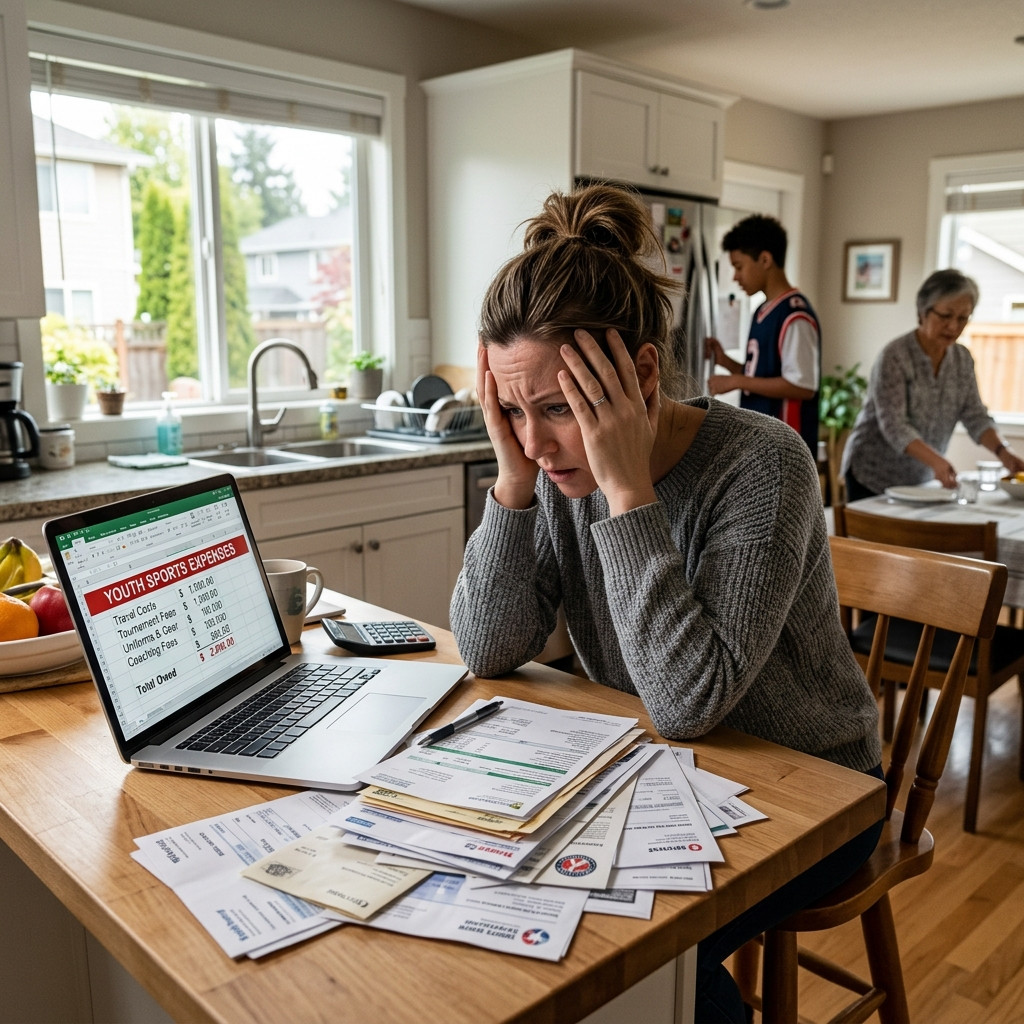
▲ The hidden costs of competitive sports can take parents completely by surprise.
Myth 2: "Public sessions are great for practice"
I figured my kid could just practice during the $10 public weekend sessions. We tried that exactly twice. Public sessions are absolute chaos. You have teenagers holding hands and drifting across the ice, toddlers clinging to plastic seals, and hockey players trying to show off. It is physically impossible, and incredibly dangerous, to practice a three-turn or a scratch spin in that environment.
To actually train, you have to buy "Freestyle Ice" sessions. These are dedicated, 45-to-60-minute sessions strictly for figure skaters working on their routines and moves in the field. Here is the kicker: freestyle sessions are not included in any membership. They cost anywhere from $15 to $25 per session.
If your kid wants to get good, they need to be on the ice at least three to four times a week. Let us do some quick math: 4 sessions a week at $20 a session is $80 a week. That is $320 a month, just for the privilege of standing on the ice. And that does not include coaching. That is literally just the rent for 45 minutes of frozen water.
Myth 3: "Group classes are enough to make progress"
Group classes are great for learning how to fall down and get back up. But once you want to pass basic skills and move into actual figure skating testing, group classes are useless. The instructor-to-student ratio is too high, and your kid will spend 80% of the class standing in line waiting for their turn to glide across a circle.
Enter the private coach. This is where the real financial pain begins.
Private coaches charge by the minute, usually billed in 20-minute or 30-minute increments. Rates range from $40 to $120+ per hour depending on their credentials (e.g., if they went to Nationals or are Master Rated). Let us say you get a mid-tier coach at $60 an hour. If your kid takes just two 30-minute lessons a week, that is $60 a week, or $240 a month.
But wait, it gets better. You have to pay for the coach's time, *and* you have to pay for your child's freestyle ice session during that lesson. So, a single 30-minute private lesson actually costs you $30 (coach fee) + $20 (ice fee) = $50. Do that twice a week, and you are looking at $400 a month just for basic, entry-level private instruction.
Myth 4: "Competitions are cheap, local events"
Eventually, your kid's coach will say those magic, terrifying words: "I think they are ready to compete." Your heart will swell with pride, and your wallet will begin to weep.
You might think a local competition just involves driving down the road and paying a $50 entry fee. Here is how the invoice actually looks when you sign up for a basic, non-qualifying local competition:
Entry Fee: $120 for the first event, $50 for each additional event.
Coach's Fee (Competition Day): You have to pay your coach for their time at the competition. This includes their travel time, their waiting time, and the time they spend putting your kid on the ice. This can easily run $100 to $200 for a single day.
Coach's Expenses: If the competition is out of town, the skaters' parents split the coach's hotel, mileage, and meals. If your coach has five kids competing, you split it five ways. If they only have two, you are paying half of their weekend trip.
The Music & Choreography Fee: You cannot just skate to a random Spotify track. You have to pay a choreographer to cut the music to exact US Figure Skating regulations and design a program. This is a one-time fee of $200 to $500.
The Dress: You cannot wear practice gear to a competition. You need a competition dress. A basic, off-the-rack dress with zero rhinestones starts at $150. If you want your kid to look like they belong there, you need rhinestones. Hand-stoned dresses start at $400 and can easily exceed $1,500. Parents literally spend hours with fabric glue and Swarovski crystals trying to save a buck.
Myth 5: "You can just avoid the club culture"
I thought we could be independent and just do our own thing. No club, no drama, no extra fees. But the system is built to force you in.
To test and move up the official US Figure Skating (USFS) levels, your child must be a member of a local figure skating club. Club membership costs anywhere from $100 to $250 a year. Once you join the club, you are expected to volunteer your time, buy club jackets (another $150), and participate in club ice shows (which require buying more costumes and paying show entry fees).
If you do not join the club, you cannot take the official tests. If you do not take the tests, you cannot compete in official events. The entire ecosystem is locked behind a paywall designed to keep the sport exclusive.
How to survive this hobby without filing for bankruptcy
If your kid is absolutely obsessed and you cannot drag them away from the ice, you have to get smart. Here are the actual, non-obvious ways to cut down on the bleeding:
1. Buy used boots, but never used blades
You can find incredible deals on gently used figure skating boots from older skaters who outgrew them in six months. Check Facebook groups specifically dedicated to figure skating buy/sell/trade. However, make sure the boot is not "broken down" (meaning the ankle support is shot). Never buy cheap, unbranded skates from big-box stores; they are dangerous and will ruin your kid's alignment.
2. Master the art of the "Semi-Private" lesson
If your coach allows it, pair up with another skater of a similar level and split the lesson cost. A 30-minute lesson split between two kids gives them plenty of individual feedback while cutting your coaching bill exactly in half.
3. Learn to stone your own dresses
Buy a plain, unembellished dress online for $60. Go to an online rhinestone wholesaler, buy a bulk pack of flat-back crystals and some E6000 glue, and spend a weekend watching Netflix while gluing crystals onto the dress yourself. You will save hundreds of dollars, and from ten feet away on the ice, nobody can tell the difference between your DIY job and a custom designer dress.
4. Limit the competition footprint
You do not need to travel three states over for a basic competition. Stick to rinks within driving distance, and limit your child to one or two competitions a year until they are old enough to actually benefit from the competitive experience.
The Final Bill: A Reality Check
Before you commit to figure skating, understand the true baseline cost. For a basic, non-elite skater practicing three times a week with minimal private coaching and two local competitions a year, you should expect to spend between $4,000 and $8,000 annually. If your child shows real promise and wants to pursue regional or national tracks, that number easily climbs to $15,000 to $30,000+ per year.
Watching athletes like Amber Glenn is inspiring, but behind every triple axel is a mountain of cash that most normal families simply cannot afford to burn. Go into this sport with your eyes wide open, or stick to the public sessions and recreational rental skates.
"Your chronic fatigue and brain fog aren't a lack of willpower—they're a lack of gut microbes." Welcome to the era of Fibermaxxing. In 2026, Silicon Valley executives and biohackers are dropping extreme diets to focus on the ultimate performance enhancer: The Gut-Brain Axis. 1. The End of the Protein Obsession For years, fitness culture was entirely obsessed with "high protein, low carb." We filled our fridges with chicken breasts and protein powders. But as we move deep into 2026, the paradigm has shifted. High performers are now turning their attention away from protein and toward Fiber . Enter 'Fibermaxxing' . Instead of restricting food groups and inducing metabolic stress, people are dramatically increasing their intake of complex, high-quality fibers—like lentils, beans, and whole grains—to reduce systemic inflammation and unlock ...
The 2026 Wellness Shift: Why 'Sleep Recovery' is the Ultimate Weight Loss Hack "I am eating less and working out endlessly, but the scale won't budge." This is the universal frustration of chronic dieters. However, as we move through 2026, the global wellness industry and viral TikTok trends have abruptly shifted focus away from high-intensity workouts and extreme caloric deficits. Today, top fitness experts and Silicon Valley biohackers are obsessed with one metric above all else: Data-Driven Sleep Recovery . When you are sleep-deprived, your body enters a state of primal emergency, aggressively storing fat around your midsection. Conversely, when you optimize your sleep architecture, your body becomes an ultra-efficient fat-burning furnace overnight. In this deep dive, we explore the trending science behind the sleep-optimization diet and provide actionable protocols you can implement tonight to transform your metabolism. Photo: Cultivatin...
🌙 When was the last time you woke up actually feeling rested? Let’s be honest. Surviving the morning on three cups of coffee and doom-scrolling until 2 AM despite being exhausted has become the norm for too many of us. But in 2026, the global elite and high-performing Millennials are flipping the script. They aren't boasting about running on 3 hours of sleep anymore. Instead, they are obsessing over 'Sleepmaxxing' —the art of using cutting-edge Sleep Tech to hack their biology and achieve the most brutally efficient, restorative deep sleep possible. 1. Quality Over Quantity: The Era of 'Amplified Efficiency' It's no longer just about sleeping for 8 hours; it's about how you sleep. The 2026 sleep industry is dominated by the concept of 'Amplified Efficiency.' High-achievers are aiming to get the restorative equivalent of 10 hours of sleep in just 6 hours. How? Through active intervention. AI-pow...



Comments
Post a Comment