[My Honest, Unbiased Review] Will leaving your AC on all day really cause an electricity bill bomb? Here is my real-life 30-day experiment.
Hi everyone! I'm an ordinary office worker in my 30s who used to be terrified of opening the air conditioning bill every summer. Up until just last year, I firmly believed that 'saving on AC means turning it on and off.' Even when it was boiling hot, I would run it for an hour, turn it off, and then turn it back on as soon as it got hot again—repeating this cycle endlessly. The result? I was sweating like crazy, and my electricity bill still came out to over 150,000 KRW (about $110 USD). I was so frustrated I couldn't sleep. So, this August, I decided to take the plunge and test the internet's famous '24/7 AC rule' myself. To jump straight to the conclusion: I almost fainted when I got the bill. Let me share this shocking secret with you right now!
1. Last Year's Painful Mistake: The Tragedy of Turning the AC On and Off
Last summer was absolute hell. Even when the mid-day temperature in August neared 35°C (95°F), I was so terrified of the progressive electricity tax that I played a high-stakes game of tug-of-war with my AC—turning it on until it got cool, shutting it off, and then turning it back on when the room got stuffy again. I must have switched it on and off at least 10 times a day. When I got home from work, I'd set the AC to 18°C (64°F) on 'turbo mode' to cool down my oven-like room, shiver for an hour, turn it off, and then turn it back on 30 minutes later dripping with sweat. 😭
My body was exhausted, my stress levels were through the roof, and the bill that arrived in early September was a whopping 154,200 KRW. Over 150,000 KRW for a single person living in a studio apartment! I felt completely ripped off. I felt like I only ran the AC for 4 to 5 hours a day, so I couldn't comprehend why the bill was so high.
2. Eureka! The Hidden Secret of Air Conditioners: Inverter vs. Single-Speed (Constant Speed)
Feeling so cheated, I started researching how air conditioner electricity bills actually work. That's when I realized I had been making a massive mistake. I had been blindly turning my AC on and off without even knowing whether it was an inverter type or a single-speed (constant speed) type. 💡
How to Easily Identify Your AC Type
- Inverter AC: Most stand-type or wall-mounted ACs released in the last 10 years (usually after 2011). Once the room reaches the set temperature, it automatically slows down the compressor to maintain the temperature with minimal power. In other words, leaving it running is much more economical.
- Single-Speed (Constant Speed) AC: Common in older models or some studio-apartment wall units. The compressor runs at 100% capacity regardless of whether it has reached the set temperature. In this case, manually turning it off once the room cools down is the way to save money.
When I checked, my AC turned out to be a 2018 inverter model. I learned a shocking fact: inverter ACs consume over 90% of their power when initially lowering the temperature, but once the room is cool, they only use about 10% of their power to maintain it. This meant every time I turned it off and on, the AC thought, 'Ah! I need to blast cold air at full power again!' and consumed maximum energy every single time. My own finger was the culprit.
3. A Bold 30-Day Challenge: Running the AC 24/7
Now that I understood the science, it was time to test it in real life. From August 1st to August 31st, I decided to run my AC 24/7 without turning it off even once for an entire month. I left it on when I went to work, when I went grocery shopping, and even when I went to visit my parents for the weekend and left the apartment empty for two days. Honestly, my heart was racing the entire time. I was constantly terrified, thinking, 'What if I end up with a 300,000 KRW bill?'
My AC Experimental Setup
- Set Temperature: Maintained at 26°C to 27°C (79°F to 81°F), which is known to be the most comfortable and economical (26.5°C when sleeping).
- Fan Speed: Set to high only when first turned on, and kept on Auto thereafter.
- Auxiliary Device: Placed an air circulator directly below the AC on oscillation mode to distribute cool air throughout the apartment.
- Ventilation: Opened the windows wide for a quick 5-minute ventilation twice a day while keeping the AC running.
Every time I walked through the door, I didn't have to wait for the room to cool down; a refreshing breeze greeted me instantly, boosting my quality of life by 300%. With the humidity constantly maintained in the 50% range, there was zero stickiness, and I spent a beautifully crisp month. However, a lingering fear of the bill still sat in the back of my mind.
4. The Bill Finally Arrives: Results I Couldn't Believe with My Own Eyes
In mid-September, the mobile bill notification finally popped up on my smartphone. I took a deep breath and tapped the screen. The moment I saw the amount, I couldn't believe my eyes.
The total bill was only 48,530 KRW (approx. $36 USD)! 😲
Last year, when I sweated through the summer turning the AC on and off, the bill was 154,200 KRW. This year, living in absolute paradise 24/7 without ever being too hot or too cold, the bill was slashed to a third of that amount. I got goosebumps, and a wave of regret washed over me. I thought, 'Why on earth did I suffer so much before?' I had no idea the energy efficiency of an inverter AC was this powerful.
5. 4 Golden Rules to Cut Your AC Electricity Bill in Half
Based on my one-month experiment, here is a summary of real AC-saving tips that even utility company employees agree with. Follow these, and you'll save at least 50,000 KRW on your electricity bill this summer.
1. Always Start on 'High' When Turning It On
Many people start with a low fan speed or fan-only mode to save electricity. This is completely wrong. An air conditioner consumes the most power while reaching the target temperature. Therefore, you should set it to the strongest setting (high or turbo mode) initially to drop the room temperature as quickly as possible, and then switch it to auto or low. This is much more cost-effective.
2. Never Turn It Off for Short 2-3 Hour Outings
This applies to inverter ACs. If you are just popping out to the local grocery store or heading to a cafe for 2 to 3 hours, it's better to leave the AC running. The amount of electricity required to cool down a heated room from scratch is far greater than the energy needed to quietly maintain a cool temperature for 2 to 3 hours.
3. Pair Your AC with an Air Circulator or Fan Facing the Unit
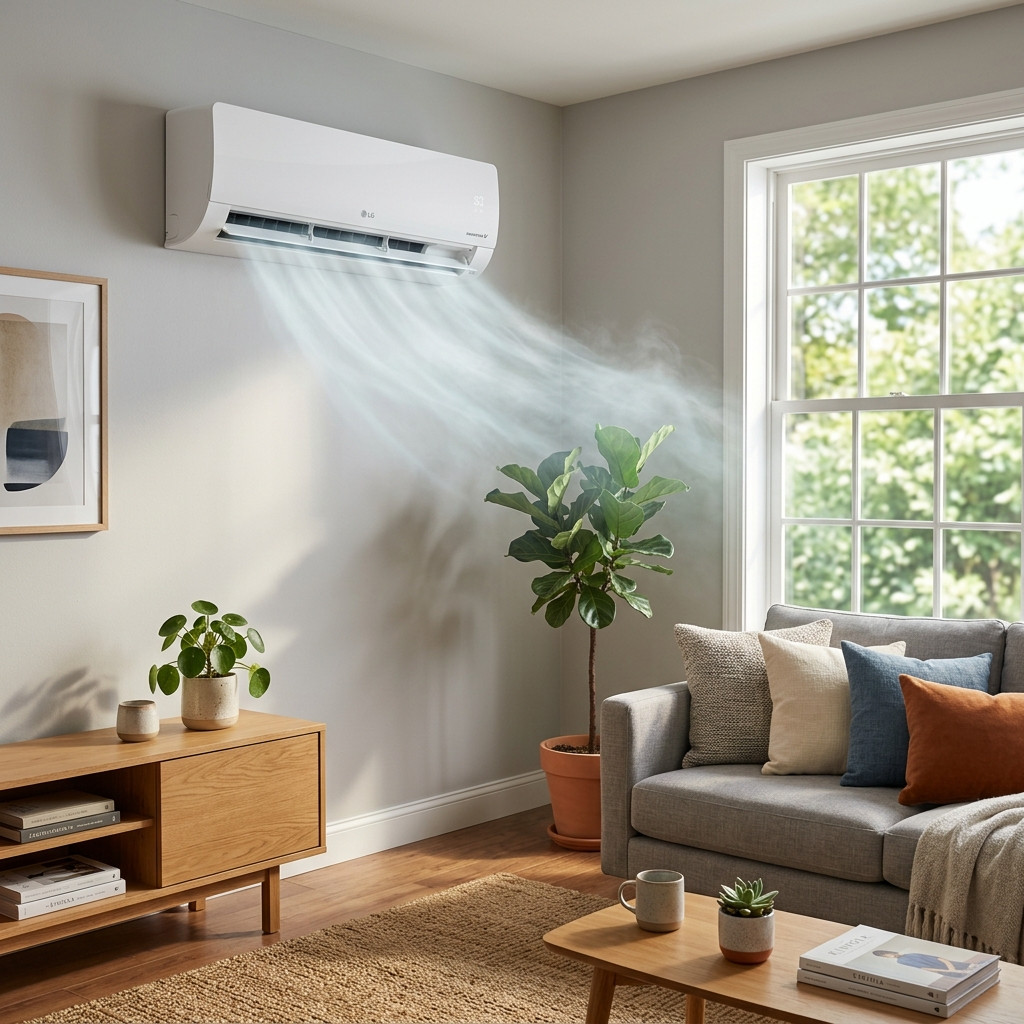
Using an air circulator in the direction of the AC's airflow speeds up air circulation, cooling the room 20% faster. Specifically, pointing the AC louvers upward and using a circulator to push air upward allows the cold air to cascade down, cooling the entire home in an instant.
4. Clean the Filters Every Two Weeks (Even If It's a Hassle)
When dust builds up on the filter, air intake decreases, causing cooling efficiency to drop sharply. Studies show that simply cleaning the filter regularly can save between 5% and 10% on your electricity bill. Just rinse off the dust with a showerhead, dry it in the shade, and pop it back in. It's easy, so don't skip it!
💡 Key Takeaways for Saving on Your AC Bill
- If your AC is an inverter model, do not turn it on and off frequently. It is much cheaper to leave it running consistently at 26–27°C (79–81°F).
- Always start on high fan speed to lower the temperature quickly when first turning it on.
- Use an air circulator alongside your AC to distribute cool air throughout your home.
- Simply cleaning the filter once every two weeks can save up to 10% on your electricity bill.
Tags: #AC Electricity Bill #24/7 Air Conditioning #Inverter vs Single-Speed #How to Save on AC Bill #Summer Electricity Bill #AC Experiment #Avoid High Power Bills #Dehumidifier AC Bill #Inverter AC #Life Hacks



Comments
Post a Comment